

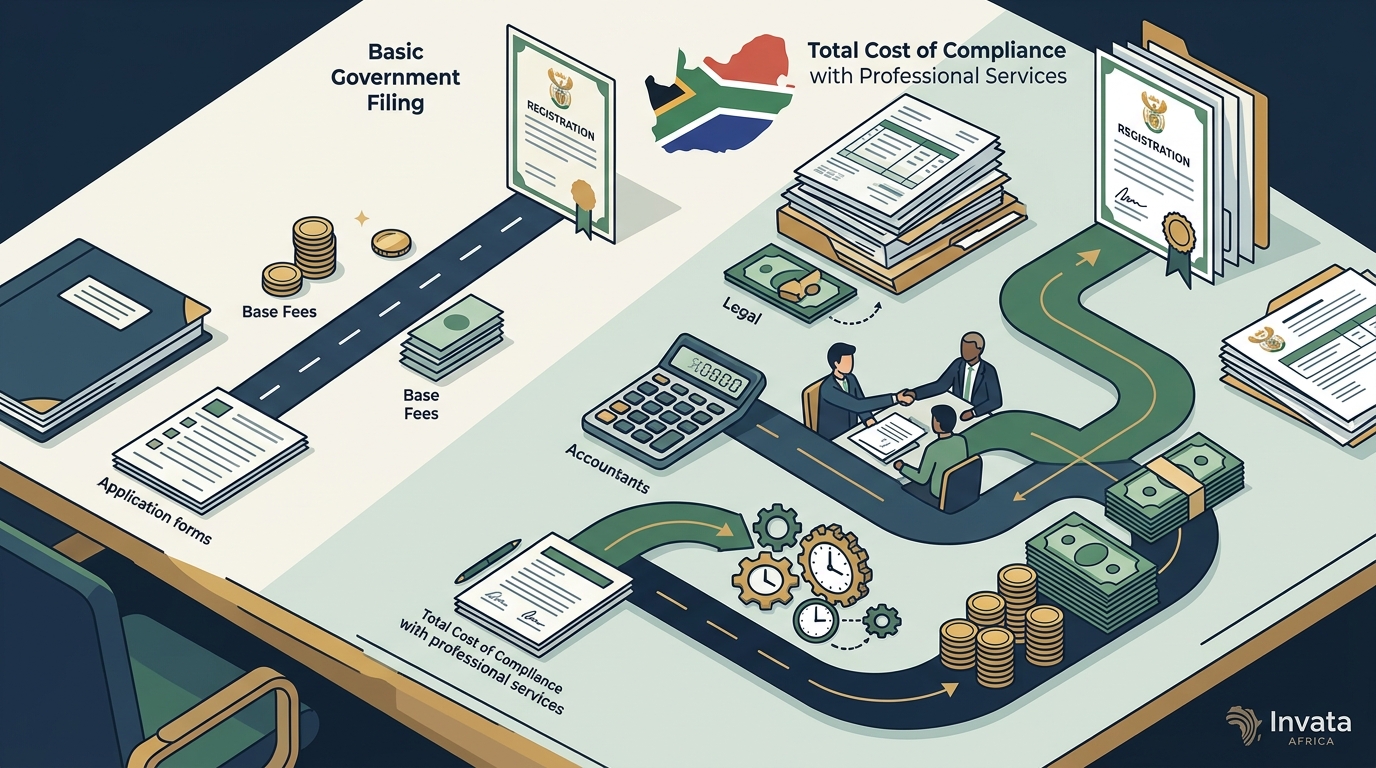
Starting a business in South Africa requires navigating a complex regulatory landscape where upfront costs can vary significantly based on your chosen structure and service provider. According to recent industry data, the base government filing fees for a private company (Pty Ltd) remain relatively low, yet the total cost of compliance often doubles when accounting for professional services and ongoing statutory requirements. This article breaks down the financial implications of different registration pathways to help you budget accurately for your venture.
Government Filing Fees and Taxes
The Companies and Intellectual Property Commission (CIPC) is the primary regulatory body responsible for business registration in South Africa. Understanding their fee structure is the first step in calculating your total startup costs. The government charges a standard fee for the name reservation process, which is typically around 50 to 100 South African Rand. This step is mandatory before you can proceed with the actual incorporation of your entity.
Once the name is secured, the actual incorporation fee for a Private Company (Pty Ltd) is approximately 175 Rand. This fee covers the issuance of the Certificate of Incorporation, which serves as the legal proof of your business existence. While these numbers seem negligible compared to international standards, they form the baseline for all subsequent costs. Any delays in processing can lead to additional administrative fees if expedited services are required.
It is important to note that these fees are subject to periodic adjustments by the government. Therefore, relying on static historical data may lead to budgeting errors. Always verify the current fee schedule on the official CIPC website before submitting your application. The regulatory environment in South Africa is dynamic, and staying updated ensures you do not face unexpected financial penalties.
Professional Service Provider Costs
While the government fees are fixed, the cost of using a professional service provider varies widely based on the level of support you require. Many entrepreneurs choose to use a registered agent or a corporate service provider to handle the paperwork. This option is particularly useful for foreign investors who may not be physically present in the country.
Basic registration packages from local firms typically range from 1,500 to 3,000 South African Rand. These packages usually include name reservation, document preparation, and submission to the CIPC. However, they often exclude critical post-registration steps such as tax registration with the South African Revenue Service (SARS). If you opt for a comprehensive package that includes tax clearance and banking assistance, the cost can rise to between 5,000 and 10,000 Rand.
Platforms like Invata Africa streamline this process by offering integrated solutions that cover multiple jurisdictions. By using a specialized platform, you can often reduce the administrative burden and avoid the hidden costs associated with manual processing errors. The efficiency gained from using a digital-first approach often outweighs the initial premium paid for the service.
Ongoing Compliance and Maintenance
The initial registration cost is only a fraction of the total cost of ownership. Ongoing compliance is where many businesses face unexpected financial drains. In South Africa, every registered company must file annual returns with the CIPC. Failure to do so can result in heavy fines and eventual deregistration of the company.
The annual return fee is approximately 175 Rand, but this does not include the cost of professional assistance. If you hire an accountant or a compliance officer to manage these filings, you can expect to pay between 2,000 and 5,000 Rand per year. Additionally, companies must prepare and file annual financial statements. For small private companies, these statements can be reviewed by a professional accountant, which adds to the annual operational budget.
Tax compliance is another significant ongoing cost. You must register for Income Tax, Value Added Tax (VAT) if your turnover exceeds 1 million Rand, and Pay-As-You-Earn (PAYE) if you have employees. The cost of maintaining a compliant tax status involves regular software subscriptions for accounting, such as Sage or Xero, which typically cost between 500 and 1,500 Rand per month.
Jurisdictional and Cross-Border Considerations
If you are looking to expand beyond South Africa, the cost structure changes dramatically. Registering a business in South Africa is often seen as a gateway to the broader African market. However, each additional jurisdiction you enter adds layers of complexity and cost. For instance, registering a company in Kenya or Nigeria requires separate filing fees, local registered agents, and potentially different capital requirements.
According to data from the World Bank, the cost of starting a business in Sub-Saharan Africa varies significantly by country. South Africa remains one of the more affordable options for formal registration, but the cost of cross-border expansion can be prohibitive for small businesses. This is where platforms like Invata Africa provide value by offering a unified interface for managing multiple registrations.
Understanding the regulatory differences between jurisdictions is crucial. Some countries require minimum share capital, while others do not. Some have stricter reporting requirements, while others are more lenient. Failing to account for these differences can lead to costly legal issues and operational delays. Always consult with a legal expert before expanding into a new market.
Cost Comparison Summary
The following table summarizes the estimated costs associated with different aspects of business registration and maintenance in South Africa. These figures are estimates and can vary based on the service provider and specific business needs.
| Cost Category | Estimated Cost (ZAR) | Frequency | Notes |
|---|---|---|---|
| Name Reservation | 50 - 100 | One-time | Payable to CIPC |
| Incorporation Fee | 175 | One-time | Payable to CIPC |
| Basic Service Package | 1,500 - 3,000 | One-time | Includes filing and support |
| Comprehensive Package | 5,000 - 10,000 | One-time | Includes tax and banking |
| Annual Return Fee | 175 | Annual | Payable to CIPC |
| Accounting Services | 2,000 - 5,000 | Annual | Professional assistance |
| Accounting Software | 6,000 - 18,000 | Annual | Software subscription |
Key Takeaways
- The base government fee for incorporating a private company in South Africa is 175 Rand, making it one of the most affordable entry points in the region.
- Professional service providers typically charge between 1,500 and 10,000 Rand for registration packages, depending on the level of post-registration support included.
- Ongoing compliance costs, including annual returns and accounting services, can add between 2,000 and 23,000 Rand to your annual budget.
- Expanding to other African jurisdictions significantly increases costs due to separate filing fees and the need for local registered agents.
- Using integrated platforms like Invata Africa can reduce administrative overhead and provide better visibility into cross-border compliance.
- Tax registration with SARS is mandatory and requires ongoing monitoring to avoid penalties, especially for VAT and PAYE obligations.
- Always verify current government fees directly with the CIPC, as rates are subject to change and can impact your initial budget.
Frequently Asked Questions
How long does it take to register a company in South Africa?
Standard processing times for CIPC registrations are typically between 3 to 7 business days. However, this can vary based on the completeness of the application and the current workload of the commission.
Can foreigners register a business in South Africa?
Yes, foreigners can register a business in South Africa. However, they may need to appoint a local director or use a registered agent service to handle the incorporation process. Invata Africa offers specific services for international entrepreneurs.
What is the minimum capital required to start a company?
There is no minimum share capital requirement for a Private Company (Pty Ltd) in South Africa. You can start with as little as 1 share, provided you have the necessary funds to cover registration and operational costs.
Do I need to pay VAT immediately after registration?
No, you only need to register for VAT if your taxable turnover exceeds 1 million Rand in any consecutive 12-month period. However, voluntary registration is possible if you anticipate reaching this threshold.
What happens if I fail to file annual returns?
Failure to file annual returns can result in heavy fines and the eventual deregistration of your company. A deregistered company loses its legal status and cannot conduct business, which can severely impact your operations and reputation.
How much does it cost to open a business bank account?
Most major banks in South Africa do not charge a fee to open a business account. However, they may have monthly maintenance fees or transaction fees that vary depending on the account type and your transaction volume.
Is it cheaper to register in South Africa or another African country?
South Africa is generally one of the more affordable and efficient jurisdictions for business registration in Africa. While some countries may have lower government fees, the overall cost of compliance and operational complexity can be higher.
Start Your Registration Today
Navigating the complexities of business registration in South Africa does not have to be a daunting task. By understanding the cost breakdown and leveraging the right tools, you can streamline your entry into the market. Invata Africa provides the expertise and infrastructure you need to form and run your business efficiently across the continent. Visit our offer page to explore our comprehensive registration packages and start your journey with confidence.